Pages

Sunday, 27 October 2013

INSPIRING LIVES -- NICK VUJICIC -- LIFE WITHOUT LIMITS

2013-39  Inspiring Lives -- Nick Vujicic -- Life without Limits


Nick Vujicic [1982- ]
[Imagine getting through your busy day without hands or feet. Picture your life without the ability to walk or care for even your basic needs. Read the success story of  Nicholas Vujicic (pronounced voo-yee-cheech), a personification of perseverance, who says, "No arms; No legs; No worries!" 

Nick gradually figured out how to live a full life without limbs. He writes with two toes on his left foot. He knows how to use a computer. He has also learned to throw tennis balls, play drum pedals, get a glass of water, comb his hair, brush his teeth, answer the phone and shave, in addition to participating in golf, swimming, soccer, and sky-diving.


Since his first speaking engagement at age 19, Nick has traveled around the world, sharing his story with millions, speaking to diverse groups such as students, teachers, young people, business professionals and church congregations of all sizes.

According to Nick, the victory over his struggles, as well as his strength and passion for life today, can be attributed to his faith in GodToday this dynamic young evangelist has accomplished more than most people achieve in a lifetime.]  


"Hi Friend,

My name is Nick Vujicic and I am thankful to have been born [1982] with no arms and no legs. I won’t pretend my life is easy, but through the love of my parents, loved ones, and faith in God, I have overcome my adversity and my life is now filled with joy and purpose. I reside now in California with my wife, Kanae, and we both love seeing people’s lives changed for the better or touched in some way. It is my hope that your life is positively impacted by my story.
I was born and raised in Melbourne, Australia, and it was a shock to my parents that I arrived without limbs. There is no medical reason for it. My parents did their very best to keep me in the mainstream school system and give me every opportunity to live to the fullest. I was blessed to have a brother and a sister as my best friends too.
We later moved to Brisbane, Australia, where I lived for 14 years before I made the move to California. At age eight, I could not see a bright future ahead and I became depressed. When I was ten years old, I decided to end my life by drowning myself in a bathtub. After a couple attempts, I realized that I did not want to leave my loved ones with the burden and guilt that would result from my suicide. I could not do that to them.
I wasn’t depressed my entire childhood, but I did have ups and downs. At age thirteen I hurt my foot, which I use for many things like typing, writing and swimming. That injury made me realize that I need to be more thankful for my abilities and less focused on my disabilities.
When I was fifteen years old, I sealed my faith in God and from there it has been an amazing journey.
A janitor at my high school inspired me to start speaking about my faith and overcoming adversity when I was seventeen. I spoke only a dozen times to very small groups over the next two years. Then I found myself in front of three hundred sophomore (grade 10) students and I was very nervous. My knees were shaking. Within the first three minutes of my talk, half the girls were crying, and most of the boys were struggling to hold their emotions together. One girl in particular was sobbing very hard. We all looked at her and she put her hand up. She said, “I am so sorry to interrupt, but can I come up and hug you?”
She came hugged me in front of everyone, and whispered in my ear, “Thank you, thank you, thank you. No one has ever told me that they loved me and that I am beautiful the way I am.”
Her gratitude inspired me to go across 44 countries and speak 2,000 times. I realized that we all need love and hope and that I was in a unique position to share that with people around the world.
While majoring in both accounting and financial planning at a university, I also worked on developing my abilities as a speaker. I worked with a speaking coach who helped to cultivate me as a presenter. He especially worked on my body language as my hands flew everywhere at first!
I spoke on motivational topics after creating the company, attitude is altitude. I also launched a non-profit ministry, life without limbs, to spread my messages of faith and hope around the world.
Whoever you are, wherever you’re from and whatever you are dealing with, I hope that you will be inspired by my story and my message. Please enjoy browsing around this website where I share with you my thoughts on faith, hope and love to encourage you and to help you overcome your own challenges.
Dream big my friend and never give up. We all make mistakes, but none of us are mistakes. Take one day at a time. Embrace the positive attitudes, perspectives, principles and truths I share, and you too will overcome.
Sincerely,
Nick
Two inspirational videos follow:

-----------------------------------------------------------------------------------------------------------------------------


-------------------------------------------------------------------------------------------------------------------------------


Sunday, 20 October 2013

DON'T CRITICISE: THE TOYS - COVENTRY PATMORE

2013-38   Don't Criticise: The Toys - Coventry Patmore


Coventry Patmore [1823-1896]
   [ Coventry Patmore (1823–1896)
wa
s one of the least known but highly-regarded Victorian poets. He was also an English critic who had a deep concern for religion. A collected edition of Patmore's poems appeared in two volumes in 1886, with his characteristic preface: "I have written little; but it is all my best. I have never spoken when I had nothing to say, nor spared time or labour to make my words true. I have respected posterity; and I dare to hope that it will respect me."
The Angel in the House is considered to be his best poem. The Unknown Eros is full of exalted thought, expressed in poetry of the richest and most dignified melody.The homely but elevated pathos of "The Toys" therein, are unsurpassed in English poetry.] 

    My little Son, who look'd from thoughtful eyes 
And moved and spoke in quiet grown-up wise, 
Having my law the seventh time disobey'd, 
I struck him, and dismiss'd 
With hard words and unkiss'd,
—His Mother, who was patient, being dead.
Then, fearing lest his grief should hinder sleep, 
I visited his bed, 
But found him slumbering deep, 
With darken'd eyelids, and their lashes yet 
From his late sobbing wet. 
And I, with moan, 
Kissing away his tears, left others of my own; 
For, on a table drawn beside his head, 
He had put, within his reach, 
A box of counters and a red-vein'd stone, 
A piece of glass abraded by the beach, 
And six or seven shells, 
A bottle with bluebells, 
And two French copper coins, ranged there with careful art, 
To comfort his sad heart.

So when that night I pray'd 
To God, I wept, and said: 
Ah, when at last we lie with trancèd breath, 
Not vexing Thee in death, 
And Thou rememberest of what toys 
We made our joys, 
How weakly understood 
Thy great commanded good, 
Then, fatherly not less 
Than I whom Thou hast moulded from the clay, 
Thou'lt leave Thy wrath, and say, 
'I will be sorry for their childishness.' 

----------------------------------------------------------------------------------


Sunday, 13 October 2013

DON'T CRITICIZE: FATHER FORGETS - W LIVINGSTON LARNED


2013-37  Don't Criticise: Father Forgets - W Livingston Larned


[ I came across "Father Forgets" for the first time in 1962, when I was 20 years old. I read it in Dale Carnegie's HOW TO WIN FRIENDS AND INFLUENCE PEOPLE. It had a lasting impact on me.   
When I talked about it to my father who was my first and foremost teacher, he simply said, "Haven't you read THE TOYS by Coventry Patmore?" which I shall upload in my next post!]
To quote Dale Carnegie: "Bitter criticism caused the sensitive Thomas Hardy, one of the finest novelists ever to enrich English literature, to give up forever the writing of fiction. Benjamin Franklin, tactless in his youth, became so diplomatic, so adroit at handling people, that he was made American Ambassador to France. The secret of his success? "I will speak ill of no man," he said, "and speak all the good I know of everybody."
Any fool can criticize, condemn and complain - and most fools do. But it takes character and self-control to be understanding and forgiving. Often parents are tempted to criticize their children. Before they criticise, let them read one of the perennial classics, 'Father Forgets.'  It originally appeared as an editorial in the People's Home Journal and is reproduced here as condensed in the Reader's Digest:"


"Listen, son; I am saying this as you lie asleep, one little paw crumpled under your cheek and the blond curls stickily wet on your damp forehead. I have stolen into your room alone. Just a few minutes ago, as I sat reading my paper in the library, a stifling wave of remorse swept over me. Guiltily I came to your bedside.

There are things I was thinking, son: I had been cross to you. I scolded you as you were dressing for school because you gave your face merely a dab with a towel. I took you to task for not cleaning your shoes. I called out angrily when you threw some of your things on the floor.

At breakfast I found fault, too. You spilled things. You gulped down your food. You put your elbows on the table. You spread butter too thick on your bread. And as you started off to play and I made for my train, you turned and waved a hand and called, "Goodbye, Daddy!" and I frowned, and said in reply, "Hold your shoulders back!"

Then it began all over again in the late afternoon. As I came Up the road, I spied you, down on your knees, playing marbles. There were holes in your stockings. I humiliated you before you boyfriends by marching you ahead of me to the house. Stockings were expensive - and if you had to buy them you would be more careful! Imagine that, son, form a father!

Do you remember, later, when I was reading in the library, how you came in timidly, with a sort of hurt look in your eyes? When I glanced up over my paper, impatient at the interruption, you hesitated at the door. "What is it you want?" I snapped.

You said nothing, but ran across in one tempestuous plunge, and threw your arms around my neck and kissed me, and your small arms tightened with an affection that God had set blooming in your heart and which even neglect could not wither. And then you were gone, pattering up the stairs.

Well, son, it was shortly afterwards that my paper slipped from my hands and a terrible sickening fear came over me. What has habit been doing to me? The habit of finding fault, of reprimanding - this was my reward to your for being a boy. It was not that I did not love you; it was that I expected too much of youth. I was measuring you by the yardstick of my own years.

And there was so much that was good and fine and true in your character. The little heart of you was as big as the dawn itself over the wide hills. This was shown by your spontaneous impulse to rush in and kiss me good night. Nothing else matters tonight, son. I have come to your bedside in the darkness, and I have knelt there, ashamed!
It is a feeble atonement; I know you would not understand these things if I told them to you during your waking hours. But tomorrow I will be a real daddy! I will chum with you, and suffer when you suffer, and laugh when you laugh. I will bite my tongue when impatient words come. I will keep saying as if it were a ritual: "He is nothing buy a boy - a little boy!"

I am afraid I have visualized you as a man. Yet as I see you now, son, crumpled and weary in your cot, I see that you are still a baby. Yesterday you were in your mother's arms, your head on her shoulder. I have asked too much, too much."


"Father Forgets" as read by Dale Carnegie:


Sunday, 6 October 2013

INSPIRATIONAL STORY: THE DAISY - HANS ANDERSEN

2013-36  Inspirational Story: The Daisy - Hans Christian Andersen


The Daisy "with gold in her heart and silver on her dress"


[I started reading Anderson’s Fairy Tales and Grimm’s FairyTales in my early ‘teens, having read Aesop’sFables earlier. If Hans Christian Anderson is considered the greatest story teller of all times, Brothers Grimm were the most famous for happy endings like “they lived happily ever after” which all children like.

“The Daisy” of Hans Anderson is one of his most poignant stories. The Daisy has been my ideal and I have drawn many lessons of life from it.  I present here only the opening of the story which gives it the appearance of a happy ending.  For the full story, please refer to The Complete Anderson].

"Now listen to this!

Out in the country, close by the side of the road, there stood a country house; you yourself have certainly seen many just like it. In front of it was a little flower garden, with a painted fence around it. Close by the fence, in the midst of the most beautiful green grass beside a ditch, there grew a little daisy.

The sun shone just as warmly and brightly on her as on the beautiful flowers inside the garden, and so she grew every hour. Until at last one morning she was in full bloom, with shining white petals spreading like rays around the little yellow sun in the center.

The daisy didn't think that she was a little despised flower that nobody would notice down there in the grass. No, indeed! She was a merry little daisy as she looked up at the warm sun and listened to the lark singing high in the sky.

Yes, the little daisy was as happy as if this were a grand holiday, yet it was only a Monday, and all the children were in school. While they sat on their benches, learning things, the daisy sat on her little green stalk and learned from the warm sun and everything about her just how good God is.

The daisy couldn't talk, but high above her the lark sang loudly and beautifully all the things that the little flower felt, and that made the daisy very glad.
The daisy looked up at the happy bird who could sing and fly, but she wasn't envious because she couldn't do those fine things, too"I can see and hear," the daisy thought, "and the sun shines on me and the forest kisses me. How gifted I am!"

Inside the fence stood all the stiff, proud flowers, and the less scent they had the more they seemed to strut. The peonies blew themselves out and tried to make themselves bigger than the roses, but size alone isn't enough. The tulips knew that they had the brightest colors, and held themselves very straight, so that they could be seen more plainly.

None of them noticed the little daisy outside, but the daisy could see them and thought, "How rich and beautiful they are! I am sure the pretty lark flies across to them and visits them. Thank God that I stand close enough so that I can see them!"

But just as she thought that – keevit -- down came the lark! But he didn't come down to the peonies or the tulips! No, indeed, he flew right down into the grass to the poor daisy, who was so overjoyed that she didn't know what to think.

The little bird danced around the daisy and sang, "How soft the grass is here, and what a lovely little flower! With gold in her heart and silver on her dress!" You see, the yellow heart of the daisy looked like gold, and the little petals around it were silvery white.

How happy the little daisy was no one can conceive. The bird kissed her with his beak, sang to her, and then flew up again-into the bright, blue air. It was at least a quarter of an hour before the daisy could recover from her joy!

Then, almost ashamed, yet sincerely happy, she peeped over at the flowers in the garden, for they had seen the honor and happiness that had come to her, and would understand her joy. 


The Daisy by Hans Anderson in Youtube Audio:


Sunday, 29 September 2013

INSPIRATIONAL STORY: THE LITTLE MATCH GIRL - HANS ANDERSON

2013-35  Inspirational Story: The Little Match Girl - Hans Christian Andersen


Hans Christian Andersen  [1805-1875] was a Danish author and poet. Although a prolific writer of plays, travelogues, novels and poems, Andersen is best remembered for his fairy tales.

The Little Match Girl (Den Lille Pige med Svovlstikkerne, in Danish, meaning "The little girl with the matchsticks") is a one of the most poignant short stories written by Hans Christian AndersenThe story is about a dying child's dreams and hope, and was first published in 1845. It has been adapted to various media including animated film, and a television musical.


Grandmother stood clear and shining, kind and lovely

It was so terribly cold. Snow was falling, and it was almost dark. Evening came on, the last evening of the year. In the cold and gloom a poor little girl, bareheaded and barefoot, was walking through the streets.

Of course when she had left her house she'd had slippers on, but what good had they been? They were very big slippers, way too big for her, for they belonged to her mother. The little girl had lost them running across the road, where two carriages had rattled by terribly fast. One slipper she'd not been able to find again, and a boy had run off with the other, saying he could use it very well as a cradle some day when he had children of his own. And so the little girl walked on her naked feet, which were quite red and blue with the cold. In an old apron she carried several packages of matches, and she held a box of them in her hand. No one had bought any from her all day long, and no one had given her a cent.

Shivering with cold and hunger, she crept along, a picture of misery, poor little girl! The snowflakes fell on her long fair hair, which hung in pretty curls over her neck. In all the windows lights were shining, and there was a wonderful smell of roast goose, for it was New Year's eve. Yes, she thought of that!

In a corner formed by two houses, one of which projected farther out into the street than the other, she sat down and drew up her little feet under her. She was getting colder and colder, but did not dare to go home, for she had sold no matches, nor earned a single cent, and her father would surely beat her. Besides, it was cold at home, for they had nothing over them but a roof through which the wind whistled even though the biggest cracks had been stuffed with straw and rags.
Her hands were almost dead with cold. Oh, how much one little match might warm her! If she could only take one from the box and rub it against the wall and warm her hands. She drew one out. R-r-ratch! How it sputtered and burned! It made a warm, bright flame, like a little candle, as she held her hands over it; but it gave a strange light! It really seemed to the little girl as if she were sitting before a great iron stove with shining brass knobs and a brass cover. How wonderfully the fire burned! How comfortable it was! The youngster stretched out her feet to warm them too; then the little flame went out, the stove vanished, and she had only the remains of the burnt match in her hand.

She struck another match against the wall. It burned brightly, and when the light fell upon the wall it became transparent like a thin veil, and she could see through it into a room. On the table a snow-white cloth was spread, and on it stood a shining dinner service. The roast goose steamed gloriously, stuffed with apples and prunes. And what was still better, the goose jumped down from the dish and waddled along the floor with a knife and fork in its breast, right over to the little girl. Then the match went out, and she could see only the thick, cold wall. She lighted another match. Then she was sitting under the most beautiful Christmas tree. It was much larger and much more beautiful than the one she had seen last Christmas through the glass door at the rich merchant's home. Thousands of candles burned on the green branches, and colored pictures like those in the printshops looked down at her. The little girl reached both her hands toward them. Then the match went out. But the Christmas lights mounted higher. She saw them now as bright stars in the sky. One of them fell down, forming a long line of fire.

"Now someone is dying," thought the little girl, for her old grandmother, the only person who had loved her, and who was now dead, had told her that when a star fell down a soul went up to God. She rubbed another match against the wall. It became bright again, and in the glow the old grandmother stood clear and shining, kind and lovely.

"Grandmother!" cried the child. "Oh, take me with you! I know you will disappear when the match is burned out. You will vanish like the warm stove, the wonderful roast goose and the beautiful big Christmas tree!"

And she quickly struck the whole bundle of matches, for she wished to keep her grandmother with her. And the matches burned with such a glow that it became brighter than daylight. Grandmother had never been so grand and beautiful. She took the little girl in her arms, and both of them flew in brightness and joy above the earth, very, very high, and up there was neither cold, nor hunger, nor fear-they were with God.

But in the corner, leaning against the wall, sat the little girl with red cheeks and smiling mouth, frozen to death on the last evening of the old year. The New Year's sun rose upon a little pathetic figure. The child sat there, stiff and cold, holding the matches, of which one bundle was almost burned.

"She wanted to warm herself," the people said. No one imagined what beautiful things she had seen, and how happily she had gone with her old grandmother into the bright New Year.

Watch Walt Disney’s mini classic “Little Match Girl” in Youtube by clicking here.


Jean Hersholt (1886-1956)  was an avid collector of Andersen editions, and among other things he translated Hans Christian Andersen's fairy tales and stories in the excellent edition The Complete Andersen (six volumes, New York 1949) - which you may now read on this web site: http://www.andersen.sdu.dk/vaerk/hersholt/index_e.html


Sunday, 22 September 2013

APPRECIATING ART: A LONELY LIFE [1873] - HUGH CAMERON

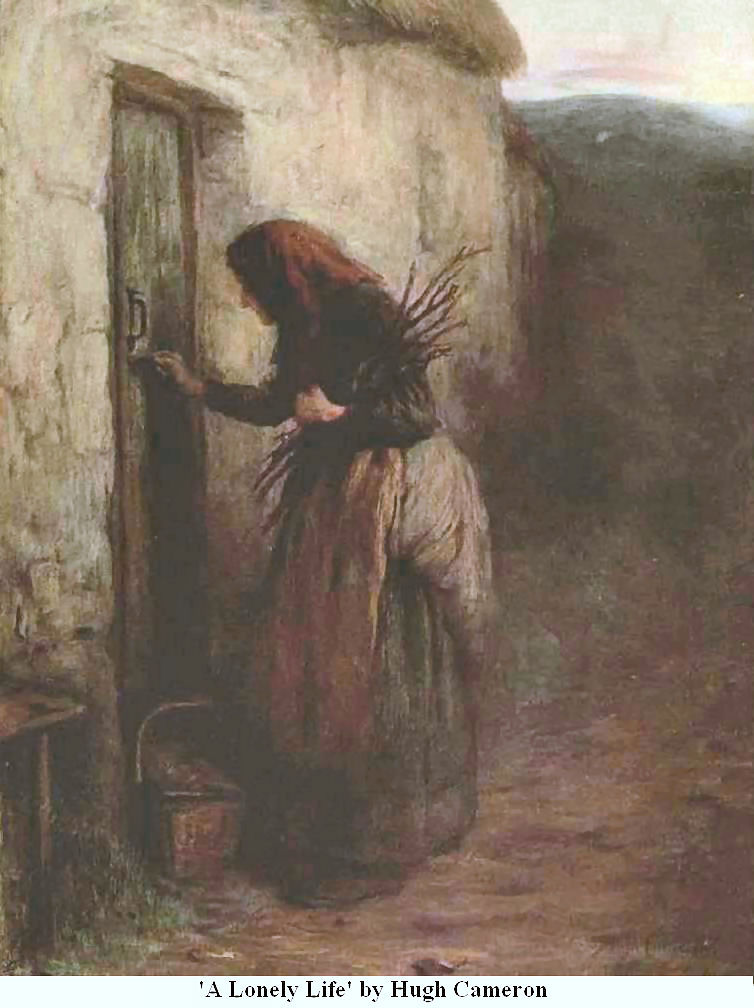
2013-34  Appreciating Art : A Lonely Life [1873] - Hugh Cameron


[During the 1870s, Hugh Cameron [1837-1918] produced a number of paintings depicting Scottish country people engaged in hard farm tasks, or collecting and dragging firewood. Several of these compositions suggest the influence of Jean François Millet's scenes of peasant life. First exhibited in 1873, this picture was painted for Cameron's friend, John McGavin who was also a discerning collector of Corot and Millet.]


You will probably agree that the title of this picture “A Lonely Life” describes it very aptly. Here we see an old Highland woman returning to her cottage at the end of the day. In one arm she carries a bundle of sticks which she has gathered on her way home, and which she will use for her evening fire.  She has set down her provision basket at her feet while she unlocks her door. There is no one to welcome her on her return-not even a dog or a cat to bark or purr when she appears in sight: truly “a lonely life.”

The arrangement or composition of the picture and its painting are as simple as the subject itself. Consider how little there is in the picture: a humble old woman and part of the outside of her poor cottage, with a little bit of sky and distant hill; and yet the painting tells its story fully and effectively.

The artist might have put many other appropriate things into his picture, such as a garden, or trees, or even other houses. Do you think that those things which might have been quite natural in such a scene would have helped him in telling his story of "a lonely life"?

The artist has put in only what was absolutely necessary, and this helps to create the feeling of loneliness, and to arouse our pity for the old woman, just as Andersen rouses our pity for the little match girl in the sad but beautiful story.

Let us notice carefully how he has treated the few items of his picture! Instead of making the different parts stand out clearly and separately from each other, he has blended them together in a wonderful way. Only the old woman's head and hands stand out clearly against the light colour of the cottage wall; all the rest of the picture is shadowy and indistinct except the distant hill crowned with a rosy cloud.

The upper part of the picture is mostly light, the lower part mostly dark. We can just see the lower part of the woman's figure, the basket, and the edge of the seat against the cottage wall, and we must imagine the road in front of the cottage, which disappears into the dark distance. See how soft and tender the painting of the picture is. There are no hard, sharp, precise outlines anywhere-everything is soft and mysterious.

There is a small window suggested at the right side of the cottage wall, and we cannot tell where the house ends and the landscape background begins. This is not carelessness on the part of the artist, but part of his plan. The painter has used only a very few colours in painting his picture - brown and grey of light and dark tones being the principal ones. He has, however, used a dull red for the woman's shawl, dull green for her skirt, and a brighter green for the cottage door.

This picture shows us that a true artist is not only a good painter, but also, like Andersen,a sympathetic story-teller.  He is not so much concerned to show us how clever he is with palette and brush, as to present before us the chosen incident in such a way as to rouse our interest and sympathy.  When we look at his picture we forget about the means which the artist employed to make it, and think only with deep sympathy of the poor old woman who lives such “a lonely life.” 

[from "Reading and Thinking Book IV p 90  by Richard Wilson, Thomas Nelson & Sons]


Watch a Slide Show of Hugh Cameron's Paintings [61] by clicking here.


Sunday, 15 September 2013

APPRECIATING ART : THE SHEEPFOLD [1856] - MILLET J F

2013-33  Appreciating Art :  The Sheepfold [1856] - Millet J F


J F Millet Self Portrait
Jean-Francois Millet  [1814-1875]  was a great French painter and one of the founder members  of the Barbizon school in rural France. He was an ardent exponent of Realism and NaturalismAlthough educated and trained in Paris, Millet was born into a peasant family from the Normandy region of northern France and he  drew on this background, specializing in scenes of peasant life. 

“The human side of art is what touches me most,” he said, "The gay side never shows itself to me. I don't know where it is. I have never seen it. The gayest thing I know is the calm, the silence, which is sweet, both in the forest and in the fields.  You will admit that it is always very dreamy, though often very delicious." 

The struggles and suffering that came to him only unfolded the great, tender,' loving spirit within him; thus while "singing the songs of the lowly" he was unconsciously developing his own nature and gaining for himself a name, an immortality that should mark an epoch in the evolution, not only of art, but of all that is good, true, and beautiful.

The Sheepfold_Moonlight


One of the most impressive pictures of Millet is “The Sheepfold” [1856-60]. 

"In the picture we have an effect of moonlight which we may have often seen, but which most of us would find it impossible to show on paper or canvas. If we examine the picture carefully we shall see that there is not very much drawing in it. Even the flock of sheep, which is the most important part of the picture, does not seem to have any very definite shape.  It is only when we begin to look at it very carefully that we see how the artist has created something very true and very real out of almost nothing. Things begin to take shape as we look more closely, just as they do at night.

If we took at the sky first, we will notice that the moon is not sharply and clearly defined, nor is it white. Next we notice that it is not round – in other words, it is not full moon.  We also see it has a halo round it, but it is so delicate and so faint that we can just see it and no more. Notice the patches of cloud in the sky; some are silver edged, and some without any light striking on them.
The hut, the sheep-pen, the man, the sheep and the dog, are all ghostly. We can see the moonlight streaming over the backs of the sheep, but we cannot see very clearly where their legs end or if they have any feet. The natural colors of grass, sheep's wool, and almost everything else have disappeared in moonlight. Only an artist like Millet could have painted such a picture and got such an effect as this."   

[ from Reading and Thinking Book IV p195  Ed by Richard Wilson, Thomas Nelson & Sons] 

"Here you have silence painted, perhaps as never expressed before. In this little moonlight you have a simple flat plain and a pen or sheepfold, made of slender poles. Beside the gate stands the shepherd; beside him his faithful dogs. Moving around and toward the fold, is a herd of sheep huddled closely together, while just above the horizon hangs the waning moon.

Into this little picture there is painted such a great sense of vastness that you lose all thoughts of dimensions and feel the real depth and breadth of nature. The whole scene is pervaded with an air of repose, a stillness that is filled with mystery, heightened by the manner in which the sheep huddle together as if some awful sound should break the stillness. That they sense the feeling of solitude, you cannot help but feel.  As you look at the sky you are seeing into endless space.

The moon is so luminous and surrounded by such a wonderful light that you fall into the prevailing sentiment of the picture and are transported to the place to become a part of the scene. You feel the moon coming forward in full relief and then gradually sinking back into the far distance, so softly, so tenderly, so lovingly that you are entranced by its beauty.  

The tone of the picture is of a bluish, silvery, purplish hue. The outlines are very indefinitely, very tenderly, let into the background, yet everything has a firmness and solidity that could not be surpassed.  The light from the moon throws long, mysterious shadows across the ground indescribable in effect.

There is always something wonderful in the color of the little touches of shadow that you find in Millet's landscapes -- a mouldy purple, but a very subdued one. This, too, is a picture that speaks to the inner senses as well as to the material sight.

Millet saw and felt the beauty that existed unappreciated in the humble life about him. To him the humble life was full of the grand poetry of humanity. To paint this and compel the world to acknowledge it was his mission."


Click on boldface headings respectively for the Slide Show and Complete Works.

I invite your special attention to
The Angelus [Catholic sunset prayer at sound of bell].